
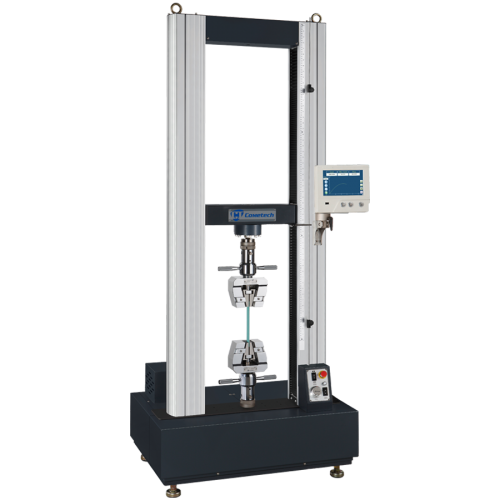

Cometech QC-505M2F Universal Testing Machine (50 kN) – Advanced Floor‑Standing Servo UTM (M2F Controller)
QC-505M2F is an advanced floor‑standing, double‑column universal testing machine with 50 kN capacity and M2F controller, providing long 1100 mm stroke, ultra‑wide speed range and up to 1200 Hz sampling for tensile, compression, bending, peel, creep and cyclic tests.
- Max. capacity 50 kN, 1100 mm test stroke (without grips), 0.0001 mm stroke resolution, force resolution 1/100,000 (≈30–31 bits).
- Speed range 0.0002–600.0 mm/min with high‑speed and low‑speed modes; data sampling up to 1200 Hz for precise control and analysis.
- Maintenance‑free servo transmission, separate control box to reduce electrical noise, plus jog wheel, anti‑collision and multi‑language M2F software for complex test sequences.
Request a quote for this product
Overview
The Cometech QC‑505M2F Universal Testing Machine is a high‑performance, floor‑standing servo UTM designed for demanding 50 kN applications, combining a large test space, long stroke and advanced M2F controller for accurate tensile, compression and flexural testing of metals, plastics, rubbers, textiles and more.
Explore more on PTS Lab:
Cometech Tensiles |
Cometech Grips & Fixtures |
Cometech Software & Controllers |
Mechanical testing equipment |
All applications
Cometech emphasizes that QC‑505M2F uses a maintenance‑free transmission mechanism and separate electric control box, which improves test stability, reduces maintenance requirements and keeps noise low in the lab.
The system relies on the M2F controller to support creep, constant compression, cycle, multi‑step test modes and user‑defined loading profiles, while a precision jog wheel allows fine positioning and calibration to maximize accuracy and prevent overload when testing at 50 kN.
Technical Specification
Standards (as listed for QC‑505M2F): ISO 7500‑1, ASTM E4, ASTM D‑76, DIN 5122, JIS B7721/B7733, EN 1002‑2, BS 1610, GB/T 228.
Official standard pages (outbound):
ISO 7500‑1 |
ASTM E4
| Control Performance | |
|---|---|
| Model | QC‑505M2F |
| Maximum capacity | 50 kN |
| Force resolution | 1/100,000 (approx. 30–31 bits) |
| Force precision | ±1% within 2–100% of loadcell capacity (higher accuracy optional) |
| Test stroke (without grips) | 1100 mm |
| Stroke resolution | 0.0001 mm |
| Space between columns | 420 mm (some distributors indicate 420–425 mm; wider options 550, 680, 800 mm are available across QC‑505 series) |
| Speed & Sampling | |
| Speed range | High‑speed mode: 0.05–600.0 mm/min; low‑speed mode: 0.0002–2.0 mm/min |
| Speed precision | ±1% |
| Data sampling rate | Up to 1200 Hz |
| Electronics & Power | |
| PC port | RJ45 (TCP/IP) – software optional |
| Motor type | Servo motor |
| Machine stiffness | Approx. 53.10 kN/mm |
| Power supply | Single phase 200–240 VAC, 8 A |
| Dimensions (W×D×H) | 90 × 60 × 195 cm |
| Weight | Approx. 280–360 kg (depending on configuration) |
M2F Control & Analysis Capabilities
- Control functions: Supports double‑curve display, defined test modes, fixed force‑rate control and constant load for long periods with automatic force‑loss compensation and rate adjustment.
- Special analysis: Can analyze specific steps in special action modes, show force–displacement relations and allow manual markup directly on curves for detailed interpretation.
- Advanced testing: Designed for creep, cycle, load/strain control, foam testing, Poisson’s ratio, slippage and other complex mechanical evaluations, with more than 260 analysis modules available.
Display Panel & Software
- 7‑inch TFT touch display (optional): Shows force, pressure, displacement and time; sets test speed, direction, auto‑return and break‑point stop; stores up to 50 test results and exports via USB; supports metric/imperial units.
- M2F software (Windows): Data sampling up to 1200 Hz, mouse/keyboard and machine up/down button control, TCP/IP communication, multi‑language UI (Chinese, English, Japanese, Korean, Portuguese, Polish, Spanish, Russian).
- Provides flexible tables and graphs, user‑defined formulas, X–Y axis adjustment (including curve marks, slopes and interval marks), as well as save/import/list/statistical comparison functions.
- Supports tensile, compression, bending, peel, spring and creep tests with various patterns such as reciprocation, creep, constant tensile/compression, test pause, slippage and up to 10‑stage sequences.
- Machine protections include over‑travel, overload and over‑time stop conditions, plus optional anti‑collision protection for loadcells at 1000 mm/min.
Machine Features & Accessories
- Auto‑identification of loadcell and displacement accessory parameters, making sensor replacement quick without manual recalibration settings.
- Jog controller enables precise displacement adjustments for accurate specimen positioning and calibration.
- Supports multi‑stage cyclic tests, long‑period load tests and reciprocating tests within a single program.
- Compatible with extensometers such as QC‑557 short extensometer (elongation below 50%) and QC‑551 long extensometer (elongation over 20%).
- Works with the full Cometech grip range (wedge tensile, bending fixtures, compression platens, cross‑peel shear, customized compression, shaft‑centering, etc.).
Documents & Downloads
-
Official manufacturer page:
QC‑505M2F Universal Testing Machine – Cometech
-
QC‑505M2F brochure (PDF):
QC‑505M2F (50 kN) Universal Testing Machine brochure
-
Distributor spec sheet:
QC‑505M2F 50 kN advanced UTM specification
Applications & Industries
- High‑force tensile and compression testing of plastics, rubbers, metals, wood, paper, textiles, tapes, electronic components, packaging and construction materials up to 50 kN.
- Standard tests including ASTM D790 / ISO 178 flexural tests, ASTM D638 plastic tensile and ASTM D412 rubber tensile (appropriate fixtures required).
- Long‑term creep and cyclic testing thanks to low‑speed capability (0.0002 mm/min) and advanced M2F control.
Related PTS Lab products:
QC‑505M1F (50 kN, M1F) |
QC‑526M2F (20 kN, M2F)
Support & Compatibility
- M2F software connects by TCP/IP to standard Windows PCs, with no strict PC hardware limitations noted, easing upgrades and IT maintenance.
- Complies with ISO 7500‑1 and ASTM E4, supporting use within accredited laboratories that require traceable force verification.
- Machine protections and anti‑collision functions help safeguard both operators and high‑value loadcells during demanding high‑force tests.